function addNumbers(a, b) {
  return a + b;
}

const result = addNumbers(5, 'hello');
console.log(result); // outputs "5hello"
If you've ever written JavaScript code like the above example - and who hasn't at 2am when they just wanted to go home - you'll know how frustrating it can be to deal with its quirks. That's why more and more developers are turning to TypeScript, the statically typed alternative that's designed to help you catch errors early. So what's the difference between TypeScript vs JavaScript? And is it worth making the switch?
Type Safety: The Big Difference
For me, the main advantage of TypeScript is its type safety features. In JavaScript, variables can hold any type of value - which can lead to some pretty weird bugs. Take this example:
let name = 'John';
name = 42; // no error!
console.log(name); // outputs 42
In TypeScript, we can specify the type of a variable when we declare it - and if we try to assign a different type later, the compiler will throw an error.
let name: string = 'John';
name = 42; // error!
// Type 'number' is not assignable to type 'string'.
What About Null and Undefined?
Another gotcha in JavaScript is the dreaded null or undefined reference error. You know - when you try to access a property on something that doesn't exist.
const user = null;
console.log(user.name); // throws an error
TypeScript can help here too - with its optional chaining operator (?.) and nullish coalescing operator (??). These let us safely navigate through potentially null or undefined values without throwing an error.
const user: { name: string } | null = null;
console.log(user?.name ?? 'Unknown'); // outputs "Unknown"
Other Key Differences
- Interoperability: Since TypeScript is compiled down to JavaScript, it's fully interoperable with existing JavaScript code.
- Type Inference: TypeScript can often infer types automatically - so you don't need to add explicit type annotations everywhere.
- Enums: TypeScript has built-in support for enums - which can make your code more readable and maintainable.
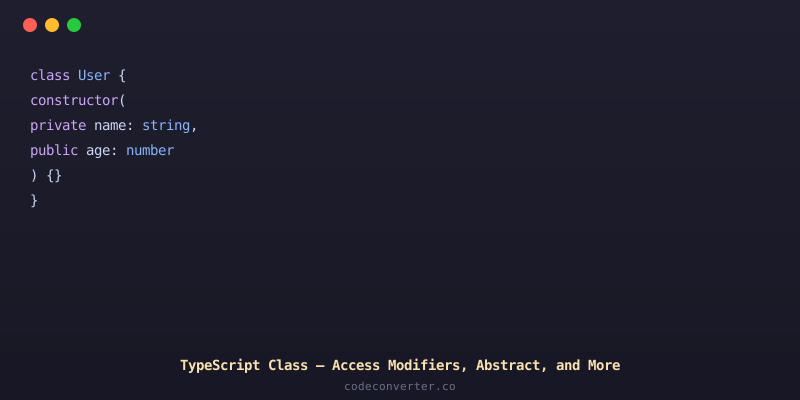
- Interfaces: Interfaces in TypeScript let you define contracts that classes must implement - helping ensure consistency across your codebase.

The Verdict: TypeScript vs JavaScript
So should you switch from JavaScript to TypeScript? I honestly prefer working with TypeScript on larger projects - but for small scripts or prototypes, JavaScript might still be fine. Ultimately, it comes down to personal preference and your specific needs. But if you're looking for a way to write more maintainable, bug-free code... I'd definitely give TypeScript a shot!
Tired of manually converting your JavaScript code to TypeScript? Check out CodeConverter.co, the AI-powered code converter that makes switching between languages a breeze!